Pinterest for Coaches: How to Drive Evergreen Traffic Month After Month
You posted something on Instagram at 9am. By 3pm it’s buried. By tomorrow it doesn’t exist.
You did the work, wrote the caption, found the hashtags, and the algorithm gave it about 48 hours of oxygen before moving on. Meanwhile you’re back at square one, trying to figure out what to post next, because if you stop posting, the traffic stops too.
That’s the hamster wheel. And if you’re reading this, you’re probably already exhausted by it.
Pinterest is not that. It is genuinely, structurally different from every other platform you’re using right now, and understanding how it works is the thing that makes coaches go from “I tried Pinterest, it didn’t do anything” to “wait, where is all this traffic coming from?”
Here’s the beginner’s guide to how Pinterest for Coaches actually works, why it compounds over time, and why it might be the last traffic strategy you need to figure out.
Pinterest Is a Search Engine. Not a Social Platform.
This is the thing most people miss, and it changes everything.
When someone opens Instagram or TikTok, they’re scrolling. They’re looking for entertainment, connection, distraction. The content they see is chosen by an algorithm based on recency and engagement. Your post has to fight for attention in real time.
When someone opens Pinterest, they’re searching. They type in “how to stop emotional eating” or “morning routine for busy mums” or “how to grow my coaching business.” They are actively looking for an answer. They want to find your content.
That’s a completely different relationship between the reader and the platform.
Pinterest themselves describe it as a “visual discovery engine”, and that framing is useful. People come to Pinterest with intent. They’re planning, researching, solving a problem. Which means the right pin, on the right keyword, in front of the right person, sends them straight to your blog or your freebie or your sales page.
No performing. No dancing. No posting at 6pm and praying for the algorithm.
Just search, discovery, click.
Why Pinterest Content Compounds Over Time
This is the part that feels almost too good to be true until you see it in your own analytics.
On Instagram, a post from six months ago is invisible. It does not bring you traffic today. You have to keep creating, keep showing up, keep feeding the machine.
On Pinterest, a pin you published six months ago can still rank in search results today. A pin from two years ago can still drive clicks. The content doesn’t die. It accumulates.
This is what people mean when they talk about “evergreen traffic.” It’s content that keeps working after you’ve stopped actively promoting it. You create it once and it continues to send people to your website, your email list, your offers.
For online coaches, creators, and sellers especially, this is great news. Your best content, your most useful posts, the things you’ve written about emotional eating or burnout or nervous system regulation or building a sustainable business, those don’t expire. The questions your clients are asking don’t expire. The searches people are making today were being made last year and they’ll be made next year.
Pinterest rewards relevance, not recency. That’s a completely different game, and it’s one that works in your favour when you have genuinely useful content to share.
How the Pinterest Algorithm Actually Works
You don’t need to understand every nuance of the algorithm to use Pinterest well. But a basic mental model helps.
Pinterest uses a combination of keyword relevance and engagement signals to decide what content to show in search results and in the home feed.
Keyword relevance means Pinterest reads the text on your pins. Your pin title, your pin description, your board name, your board description, even the alt text on your images. It cross-references that text with what people are searching for and decides whether your content is a match. This is why keyword research matters on Pinterest in a way it doesn’t really matter on Instagram.
Engagement signals mean Pinterest tracks whether people are clicking, saving, and engaging with your pins. A pin that gets saved is a pin Pinterest will continue to show in search results because it’s telling Pinterest: “people found this useful.” Saves are the currency of Pinterest distribution.
Fresh content matters too. Pinterest favours new pins, which is why consistency helps, but not in the way Instagram demands. You don’t need to post daily. A steady rhythm of new pins pointing to your best content is enough to keep the algorithm showing your work.
The short version: good keywords plus useful content plus consistent pinning equals reach that grows over time.
Who Pinterest Actually Works For
Not everyone. Let’s be honest about that.
Pinterest works brilliantly for coaches, course creators, and digital product sellers because their content maps to the questions people are already searching for. Health coaches, business coaches, life coaches, mindset coaches, all of these industries have large, active Pinterest audiences who are looking for exactly the kind of content and solutions you offer.
It also works well if you have, or are building, a content library. Blog posts, freebies, lead magnets, landing pages, digital product shop pages. Pinterest is a traffic driver. It needs somewhere to send people. If your business model is built around an email list, a blog, or a digital product suite, Pinterest is set up to support that.
It works less well for service businesses that are fully referral-based, or for people selling high-touch one-to-one services where the buyer journey is more relationship-dependent than search-dependent.
But if you’re a coach with a programme, a course, a freebie, a blog? Pinterest is arguably the most efficient content marketing channel available to you right now.
What “Evergreen” Actually Means for Your Business
Here’s the practical version of everything above.
Evergreen traffic means you write a blog post, you create a set of pins for it, you publish them, and then you move on. That content keeps sending people to your website while you’re on school pickup, while you’re with a client, while you’re asleep. (I’m building this business from abroad, in the middle of perimenopause, with three children underfoot. The idea of a traffic channel that doesn’t need me to be online at all times is not optional. It’s survival.)
Over time, as your content library grows and your keyword strategy gets sharper, the traffic compounds. Month one doesn’t look like much. Month six starts to look interesting. Month twelve you’re looking at your Google Analytics thinking “where is all this coming from?”
It doesn’t happen overnight. Anyone who tells you otherwise is selling something. But it does happen, and it keeps happening without you having to restart it every 48 hours.
That’s the actual value of Pinterest. Not just traffic. Time back.
The One Thing Most Online Biz Owners Get Wrong About Pinterest
They treat it like Instagram.
They post pretty images without keyword research. They describe their pins like captions instead of search results. They don’t have a content strategy, just a vague plan to “be more consistent.” They give it three weeks and when nothing dramatic happens, they conclude it doesn’t work for them.
Pinterest takes longer than Instagram to get going because it’s building compounding equity, not chasing an algorithm that rewards you immediately and forgets you tomorrow. The ramp-up is longer. The payoff is bigger and more durable.
The coaches who do well on Pinterest are the ones who understand what it is, set it up properly, and keep going with a strategy that fits how the platform actually works.
You Don’t Have to Figure This Out Alone
If this is making Pinterest feel more possible (and slightly less intimidating), that’s the idea.
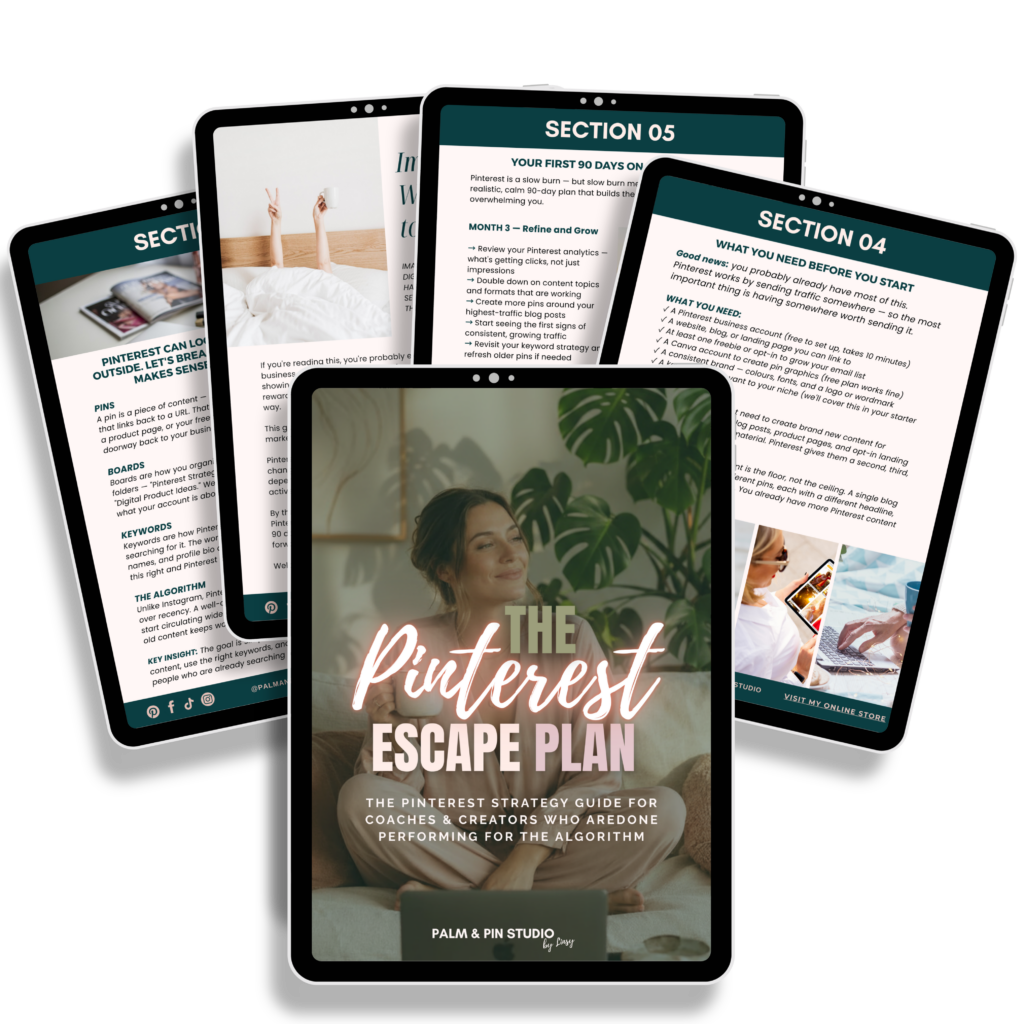
The Pinterest Escape Plan is a free resource I put together for coaches, creators and digital product sellers who are done with Instagram and want to actually understand how to use Pinterest as a traffic engine without it becoming another full-time job. It walks you through the foundational strategy, what to prioritise first, and how to set yourself up for the kind of growth that keeps working in the background.
Grab it here. No hard sell, no 47-email sequence. Just the strategy, clearly explained.