Pinterest vs Instagram: Which One Drives More Traffic, Leads, and Sales?
Let me tell you something that might be a little controversial.
Instagram might not be the right platform for your business. And I don’t mean “take a break” or “try posting less.” I mean it might genuinely not be where your time and energy belongs, and the sooner you figure that out, the better.
I know. Everyone’s on Instagram. Everyone says you need Instagram. It feels like the default option for coaches and digital sellers, the thing you just do, like you’d feel behind if you weren’t there.
But here’s what nobody really talks about: Instagram requires a daily performance in exchange for traffic that disappears in 48 hours. Pinterest requires consistent but manageable effort in exchange for traffic that compounds for years.
Those are fundamentally different deals.
This post is my honest comparison of both platforms. No agenda, no “Pinterest is magic and Instagram is evil” (it’s more nuanced than that). Just the real breakdown, so you can make an actual decision about where to put your energy.
The Fundamental Difference Nobody Talks About
Before we get into the side-by-side comparison, there’s one thing you need to understand, because it’s the foundation of everything else.
Instagram is a social platform. Pinterest is a search engine.
On Instagram, you’re broadcasting content to an audience that follows you (or might stumble across your Reel). The content is consumed in the moment and then gone. The algorithm prioritises recency and engagement. Stop posting for two weeks and your reach tanks.
On Pinterest, people are actively searching for solutions to specific problems. They type a query into the search bar and Pinterest serves them the most relevant content it can find, regardless of when that content was created. A pin you wrote 18 months ago can appear in someone’s search results today.
This single difference cascades into everything: how long your content lasts, how much effort it requires, what kind of clients it attracts, and how it converts.
Content Lifespan: 48 Hours vs 2 Years
Let’s be very honest about this.
Instagram: The average post has a lifespan of around 24-48 hours. A Reel might push that to a week or two if the algorithm picks it up, but for most coaches, most posts are effectively invisible within a couple of days. You pour time and energy into creating content that has an expiry date.
Pinterest: A well-optimised pin can drive traffic for months or years. There are documented cases of pins from 2019 and 2020 still appearing in search results and sending clicks today. The content compounds. What you create this month keeps working next year.
This is not a small difference. For coaches running a business solo (which, hi, that’s most of us), the idea that your content has a shelf life of 48 hours versus 18 months is enormous.
Effort Required: What Each Platform Actually Asks of You
Instagram asks for:
Daily or near-daily presence. Stories, posts, Reels. The algorithm rewards consistency, and consistency on Instagram is relentless. You’re not just creating content; you’re performing it. Showing up on camera, engaging in comments and DMs, staying visible. It’s a relationship that requires constant feeding.
For some people, this is fine. If you genuinely enjoy being on Instagram, if it energises you, if you have the bandwidth, it can work really well. But if you’re already stretched, adding daily Instagram performance to your to-do list can become a grind very quickly.
Pinterest asks for:
Consistent but not daily effort. Most Pinterest strategies work well with 10-30 pins per week, which sounds like a lot but can be batched in a couple of hours once a month with the right system. You’re creating evergreen content, not performing for an audience in real time. No camera required. No DMs to manage. No algorithm demanding you show up every single day.
The trade-off is that Pinterest is slower to build. You won’t go viral on Pinterest the way you might on Instagram Reels. But you’ll build sustainable traffic that doesn’t evaporate the moment you step away.
Audience Intent: Who Is Actually Ready to Buy?
This is the bit that really matters for coaches and digital sellers.
Instagram audience intent: Social. People on Instagram are there to be entertained, inspired, and connected. They’re not necessarily looking for solutions to specific problems. When they encounter your content, it might catch their attention, but the purchase intent is generally lower. You’re interrupting their scroll. You have to work hard to convert that casual viewer into a buyer.
Pinterest audience intent: Solution-seeking. People go to Pinterest when they have a specific question or problem. They’re in research mode, actively looking for answers. “How do I get more coaching clients?” “What should I eat to balance hormones?” “How do I create passive income?” These are real searches that real people type in, and they’re ready to click through, read more, and act.
For digital sellers especially, this intent gap is significant. Someone who found you because they were actively searching for what you offer is much warmer than someone who happened across your Reel during their lunch break.
Conversion Rates: Which Platform Actually Drives Sales?
I want to be careful here because conversion rates vary wildly depending on your offer, your content quality, and how well your funnel is set up. So I’ll speak in patterns rather than made-up statistics.
What I can tell you is this:
Pinterest traffic tends to convert well for:
- Lead magnets and freebies (high click-through to landing pages)
- Blog content that warms people up before presenting an offer
- Lower to mid-ticket digital products with clear, searchable benefits
- Anything that answers a question someone was already asking
Instagram tends to convert well for:
- High-touch, high-ticket offers where relationship is everything (coaching programmes, done-for-you services)
- Launches where you’re warming up an audience you’ve built over time
- Products with strong visual appeal that benefit from demonstration (think fashion, food, interiors)
Here’s the nuance: Instagram can absolutely drive sales, especially for coaches who’ve built a genuine, engaged community there. The question is the return on effort. What are you getting per hour of time you spend on each platform?
For most coaches selling digital products and mid-ticket programmes, Pinterest’s ROI over 12-24 months tends to be higher, even though it starts slower.
Who Each Platform Is Actually Right For
Let me break this down simply.
Instagram might be right for you if:
You genuinely enjoy showing up on camera and engaging with your audience in real time. Your offer is high-touch, high-ticket, and relationship-dependent. You already have an engaged following and you’re seeing real results from it. You have a team or a content system that makes consistent posting sustainable.
Pinterest might be right for you if:
You’re exhausted by the pressure to perform daily on social media. You sell digital products, have a blog, or want to build an email list through a freebie funnel. Your ideal client is a woman aged 25-55 (the overwhelming majority of Pinterest’s user base). You want traffic that builds over time without demanding your daily presence. You’re a one-person business who needs to be strategic about where your time goes.
Both might make sense if:
You have the capacity to maintain both consistently, or you use Instagram for relationship and community building while using Pinterest to drive evergreen traffic to your content and offers. A lot of successful online coaches do exactly this: they batch their Pinterest content once a month and let it run in the background while Instagram handles the real-time connection side.
The Instagram Burnout Problem (And Why It’s Not Your Fault)
Can we just acknowledge something? A lot of coaches are exhausted.
Not because they’re lazy or bad at content. Because the platform they’ve been told to prioritise demands relentless output in exchange for increasingly unpredictable results.
The Instagram algorithm has changed dramatically over the past few years. Organic reach has declined. The pressure to produce Reels, Stories, carousels, and daily posts is real. And underneath all of it is this low-level anxiety: if I stop posting, everything stops.
That’s not a content strategy. That’s a treadmill.
Pinterest isn’t perfect (nothing is), but it doesn’t punish you for taking a week off. It doesn’t require you to perform every day. It doesn’t make you compete with trending audio and viral dances to get your content seen.
For coaches who built their business to have freedom, that matters.
The Honest Verdict
Here’s my take, and you can do with it what you want.
Instagram isn’t wrong. It’s just not the only option, and it’s definitely not the most sustainable option for a lot of coaches and digital sellers.
If your current Instagram strategy is working, bringing in consistent traffic, leads, and sales without burning you out, don’t fix what isn’t broken.
But if you’re showing up every single day, spending hours on content, and still not seeing the traffic and income you want? It might not be a content quality problem. It might be a platform problem.
Pinterest won’t replace Instagram overnight. But give it six to twelve months of consistent, strategic effort and it can become the backbone of your traffic strategy. The stuff that works even when you’re on holiday, even when you take a week off, even when you just need a break.
That’s worth something.
If you’ve been nodding along to this and thinking “okay, I want to actually try Pinterest properly,” I’ve made it easy to start.
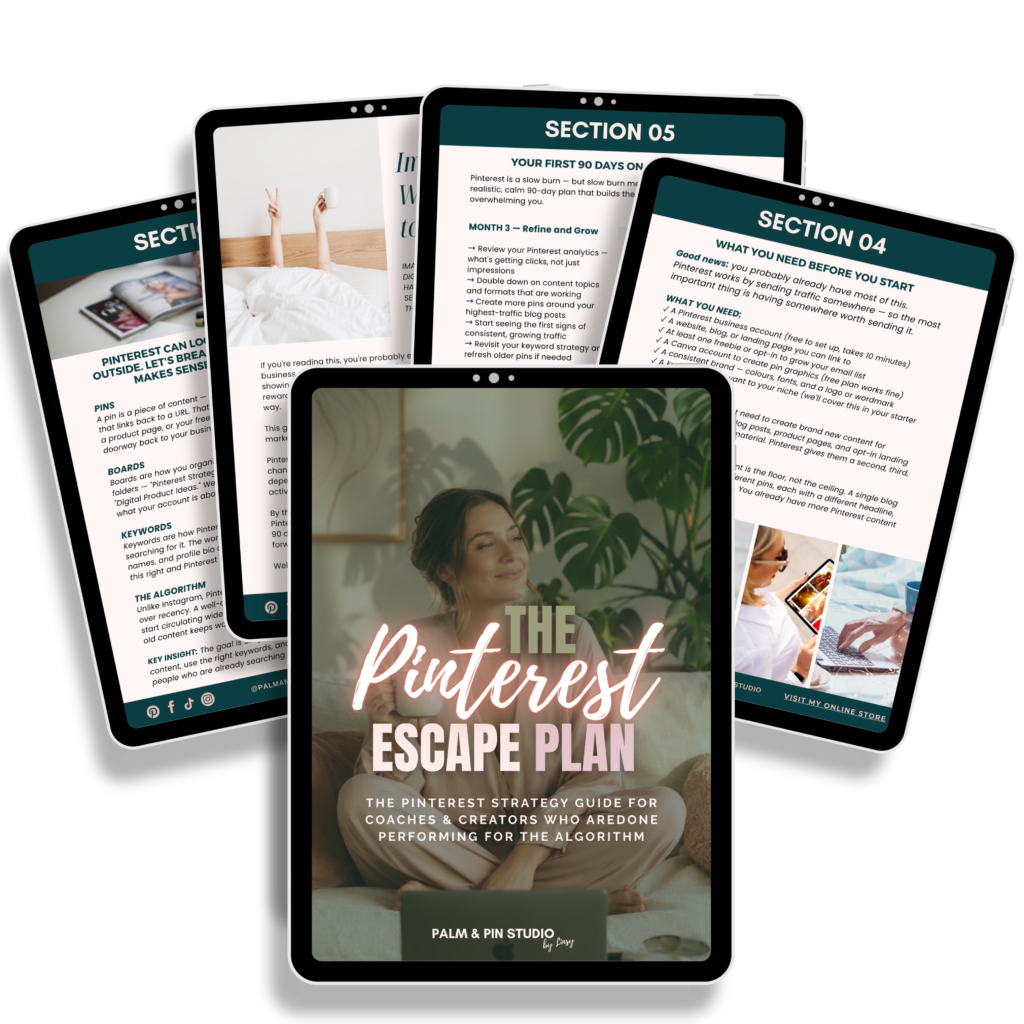
The Pinterest Escape Plan is my free guide to getting set up and seeing real results on Pinterest without the overwhelm. It’s the starting point I wish I’d had.
Grab it below and let’s get you off the hamster wheel.